
There’s a full moon in February and it’s called a Snow Moon. That evokes all sorts of images, doesn’t it? It’s the traditional name for February’s full moon and the name comes from the heavy snowfall that’s typical in the Northern Hemisphere this month.
Night is mysterious, illuminated by a moon or cloaked in darkness by the orb’s absence. Things may go bump in the night, whether the landscape is blanketed by snow or not. This month, Janet and D. Z. discuss how moonlight and darkness feature in our stories.
Nighttime heightens the senses and stirs the imagination. Darkness provides atmosphere and covers all sorts of crimes. Things look different at night. We shy away from the shadows—and what might be lurking there.
I write a historical mystery series set in the early 1950s featuring Jill McLeod. Jill is a Zephyrette, a member of the onboard crew of the streamliner train known as the California Zephyr, traveling back and forth from the San Francisco Bay Area to Chicago. Her job makes for long days that often stretch into the night. Jill is glad to go to her compartment for some much-needed sleep.
In Death Deals a Hand, the second book in the series, Jill is in bed, asleep, when the conductor knocks on her door. As she sits up in bed, she thinks:
There was only one reason anyone would wake her in the middle of the night—a crisis of some sort.
Indeed, there is a crisis. One of the passengers has been murdered.
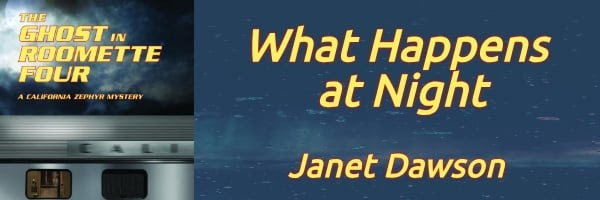
The next book in the series is The Ghost in Roomette Four. Jill is up late, with her first aid kit in hand, returning to her quarters after doctoring a child back in one of the sleeping cars. And then—well, I’ll let the first few paragraphs set the scene.
I am not seeing this, Jill MacLeod told herself. But she was.
Light shimmered at eye level, about ten feet in front of her. The apparition seemed to have no source. None, anyway, that Jill could discern. What’s more, she could see through it.
Jill took a step toward the light. It brightened, then dimmed. She took another step. The light flickered and moved into roomette four.
She shook herself. A few more steps, then she stopped at the open doorway of the roomette and peered inside.
Empty.
. . . .Surely it was just a trick of the light. But what light? How? There was nothing but darkness outside the roomette’s window.
In my Jeri Howard series, my protagonist is a private investigator in Oakland, California. Most of her cases are routine, though every now and then she finds herself out after dark. In Kindred Crimes, the first in the series, she’s at an antique shop on Piedmont Avenue, waiting for someone who promised to give her more information about the case she’s working on. It’s a wild rainy night, and the person in question hasn’t arrived. As the minutes tick past, Jeri feels uneasy. She goes out to the alley to have a look around.
I walked toward the car, feeling dread in the pit of my stomach. I could see something lying along the wall of the building, in front of the tires, something black and shiny that looked like a sack of garbage, but wasn’t. It was a raincoat. Crumbled under the raincoat I saw legs and a pair of feet, one shoe on and the other in a puddle of water nearby.
And in Take a Number, Jeri finds herself climbing over a wall, because it’s nighttime and the gates are closed at Mountain View Cemetery in Oakland.
There’s something about a cemetery at night that brings a chill to the base of the spine and makes me recall all those ghost stories told around a summer campfire when I was a kid. . . . I pushed back the specters and focused on reality, telling myself that even if I was sneaking into a cemetery in the middle of the night, most of the residents were dead and presumably couldn’t hurt me.
Lindsey Page, the protagonist of my suspense novel What You Wish For, was a graduate student at the University of California in 1974. On a February night, she’s walking home from a nighttime session with a fellow research assistant.
In the downstairs apartment, the Rolling Stones sang about standing in the shadow. The street was dark, pierced here and there by porch lights and street lamps. As she walked toward the corner, Lindsey saw the blue Volkswagen Bug, its engine still running. That was odd. She’d arrived at Art’s apartment sometime between six-thirty and seven and it was after nine. Had the car been sitting there all this time?
Yes, it has, as Lindsey finds out during the next few minutes. She hears gunfire and watches, stunned, as Patty Hearst is dragged from her apartment and stuffed into the trunk of a car.
My father was a Robert Service fan, a fine Canadian poet, who painted many indelible images with his words. One such is this: “Strange things are done in the midnight sun by the men who moil for gold.” The same is true of the moonlit night.
Oh, I could go on waxing poetic, but it is time for me to admit how much I love writing scenes that take place in the dark, moon-filled, moonless, or storm-filled night. Besides, it is February, a month when romance, murder, and longing are part of the shadowed patina of night.
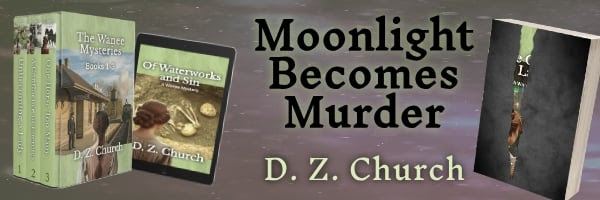
So, here you go with a few moony bits from the Wanee Mysteries.
Unbecoming a Lady:
Cora glanced overhead as clouds scudded past the rising moon, then clustered, blocking it. But for her stop at Library Hall, she would have beaten the sunset and the threatening sky. Calling herself foolish, she stepped across the street to the park and onto the dirt pathway that followed the edge of the pond toward Park Street and Countryman House, convinced that neither suspect knew they were near undone. And there had not been time, even for the Wanee busybodies to inform anyone of her stop at the site of Michael Thomas’s hanging.
A Confluence of Enemies:
Cora’s eyes flew to the screen door as it eased open. She stood, blocking Mr. Kanady’s body from the intruder, the dress fallen to her feet. A woman, by the long skirt, toed into the dim light. The interloper pulled a scarf from her head, letting loose a torrent of blond curls lit by moonglow. Miss Bales put a finger to her lips and pointed out the door to where Josiah slept in his chair.
“I have spent the night with the crowd in the park,” Miss Bales whispered, “And have much to share with you. Come with me into the garden where we can speak freely.”
One Horse Too Many:
They bounced for miles along the road to Cambridge, through increasing snowfall until visibility was so poor they might not have seen Kanady if he were two feet from the rig. Still, they both scanned the roadway, the desperation of their search for him growing with each passing bump of the wheels. As they neared the only crossroad between Wanee and Cambridge, the wavering form of a single horseman plodded their way. The rider’s head nodded with each step the bobbling-headed horse took. The reins hung loose, scraping the snow on the road. Josiah stood in the seat and hailed the rider despite Cora tugging at his coat in case it was a member of the presumed gang.
Of Waterworks and Sin:
Cora and Doc strolled up the fringes of the park arm in arm as stars appeared first high overhead, then above the horizon. A quarter of a hazy late spring moon hung in the eastern sky. Doc halted once, listening for a repeat of some hushed noise behind them.
“Cora, I wish ….”
“Do not say more, please, Philip. I do not need your condescension. Let us chalk Galena up to my first step toward being a woman of independence. I feel more confident in my abilities because of today, as though I shed my girlhood. I am unsure what will emerge, but I think a fine, strong, brave woman up to all good things. If you cannot accept that, then …”
The Orleans Lady (Available March 15):
A dog barked, and somewhere up the shallow grade to town, a baby cried. Cora tied her shawl and leaned on the railing. The gaslights lining the promenade guttered and went out. Cora took note of this. She studied the cusp of the moon, made a motion with her hand, and determined it was not only waning, but that the next night would be a new moon. Without a town to light the shore, the coming night would be dark as black velvet.
And there you have it.
Murder by moonlight, romance in moonlight, moonlight marking the way, hiding the killer, sending chills up your spine, or bringing ohs to your lips. Have a lovely February.